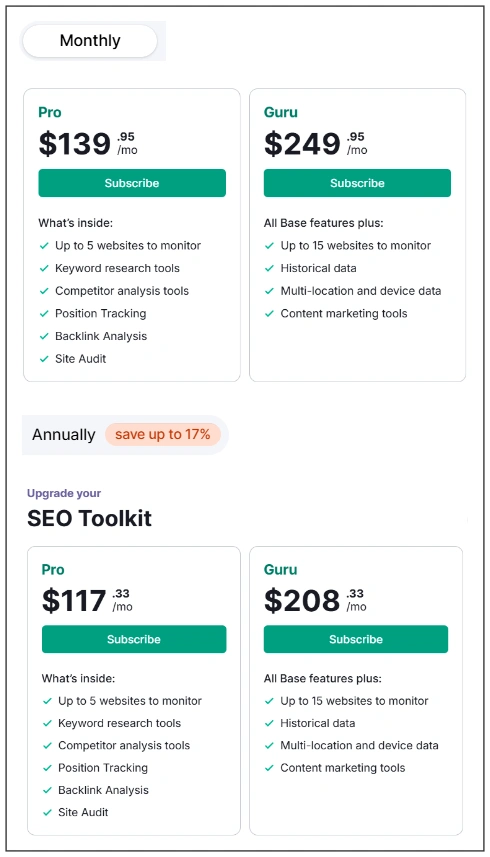
Pro starts at $139.95/mo (or $117.33/mo billed annually) and covers solo SEOs or small teams doing standard keyword research, rank tracking, and audits. Guru jumps to $249.95/mo ($208.33/mo annually) but unlocks historical data, multi-location tracking, content tools, and 3x more keyword monitoring capacity. If you're managing more than 5 sites or need trend data, Guru is the logical step up.
The Real Difference Nobody Talks About
On the surface, both plans share the same core toolset. Keyword research, competitor analysis, backlink analysis, Site Audit, Position Tracking — all of it is available on Pro. But the limits are where Pro starts to feel tight.
Pro gives you:
- 5 websites to monitor
- 500 keywords to track (daily updates)
- 100,000 pages crawled per month
- 10,000 results per report
- 3,000 reports per day
- 250 keyword metric updates per month
- 1 target per monitored website
- 500 SEO Idea Units per month
Guru gives you:
- 15 websites to monitor
- 1,500 keywords to track (daily updates)
- 300,000 pages crawled per month
- 30,000 results per report
- 5,000 reports per day
- 1,000 keyword metric updates per month
- 10 targets per monitored website
- 800 SEO Idea Units per month
💡 That's not a minor upgrade — that's a fundamentally different working capacity. The 3x keyword tracking and 10x target-per-website difference matters enormously at scale.
Pricing Breakdown: Monthly vs Annual
Before anything else, the numbers straight:
If you're committing to either plan for a full year, the annual billing makes a noticeable difference — especially on Guru where you're saving roughly $41/month. Semrush advertises "save up to 17%" on annual billing across both plans.
Where Pro Actually Works Fine
Honestly, Pro is underrated for what it does within its limits. If you're a freelance SEO managing 3–4 client websites, running monthly audits, and doing focused keyword research for a niche — Pro covers that workflow without breaking. The 500-keyword tracking limit sounds tight on paper, but in practice, most individual campaigns rarely push past that for a single client.
What Pro doesn't do:
- No AI Search Site Audit (Guru-exclusive)
- No historical keyword data — you only see current metrics
- No Keyword Cannibalization report
- No Looker Studio integration for reporting
- No JavaScript rendering during site crawls
- No Topics feature in keyword analytics
- No multi-location and device data in position tracking
⚡ The multi-location tracking gap matters more than people think. If you're tracking any client with regional pages or device-specific performance goals, Pro leaves you blind on that dimension entirely.
Where Guru Earns Its Price Tag
The feature that quietly justifies Guru for most serious SEOs is historical data. When you're analyzing a competitor's keyword trajectory or trying to understand why your traffic dropped six months ago, having access to historical metrics isn't a nice-to-have — it's essential. Pro users are flying blind on anything outside the current snapshot.
Guru also unlocks 10 targets per monitored website versus just 1 on Pro. If you're tracking competitors at a granular level — different landing pages, regional competitors, device breakdowns — this matters enormously.
Other Guru-only features worth calling out:
- Keyword Cannibalization report — flags when your own pages are competing against each other for the same keyword
- AI Search Site Audit — helps you understand how your site performs in AI-driven search environments
- Looker Studio integration — for agencies delivering visual reports to clients
- JavaScript rendering in site crawls — essential for React/Vue/Angular-based websites
- Content marketing tools — topic research and content optimization beyond pure SEO
The Add-Ons Conversation
Both plans support Semrush's add-on marketplace, which includes Additional Users, Lead Generation, Base Report, and Pro Report. Neither plan includes multi-seat access by default — additional users are purchased separately. If you're an agency with 3–4 people needing access, factor that cost into your comparison before deciding between Pro and Guru.
My Real Experience: When I Switched From Pro to Guru
I was on Pro for about eight months managing four client sites. Honestly, it held up fine — until I took on a fifth client who needed competitor benchmarking going back 12 months.
The historical data wall hit immediately. Semrush Pro simply doesn't show you trend history — every metric is a current point-in-time snapshot. I couldn't build the kind of "here's what shifted in your market six months ago" narrative that clients expect in a strategic audit.
That one project justified upgrading. The historical data access, combined with the Keyword Cannibalization report — which flagged 14 cannibalization issues on one client's blog alone — made the price difference feel almost trivial in context.
Semrush Pro vs Guru: Side-by-Side
Pros & Cons: Pro Plan
✓ Pros
- More affordable entry point
- Full access to core keyword, backlink & audit tools
- Sufficient for solo SEOs and small agencies
- Annual billing drops cost significantly
✗ Cons
- No historical data — major blind spot
- Limited to 5 sites & 500 tracked keywords
- Missing advanced reporting (Looker, JS rendering)
- Only 1 target per monitored website
- No content marketing tools
Pros & Cons: Guru Plan
✓ Pros
- Historical data — changes everything for strategy
- 3x keyword tracking capacity
- Multi-location & device-level position tracking
- JavaScript rendering for modern web architectures
- Keyword Cannibalization report included
- Content marketing tools built in
- Looker Studio integration for client reporting
✗ Cons
- $110/month more than Pro (monthly billing)
- Overkill if managing only 1–3 sites
- Content tools overlap with Surfer/Clearscope
Should You Consider Alternatives?
If Semrush's pricing feels steep regardless of plan, tools like SE Ranking and Mangools offer solid keyword and ranking features at a lower price point. Neither matches Semrush's data depth, but for tighter budgets or simpler workflows, they're legitimate options.
SE Ranking
More affordable, good for small businesses and freelancers. Solid rank tracking and on-page SEO tools. Meaningful step down from Semrush in data depth but much lighter on the wallet.
Try SE Ranking →Mangools
Beginner-friendly, clean interface, excellent value for keyword research specifically. Weaker on competitive research and technical audits, but perfect for solo bloggers on a budget.
Try Mangools →Ubersuggest
Neil Patel's SEO Tool — keyword research, site audit, and competitor analysis at a very affordable price. Great for beginners and small business owners on a tight budget.
Try Ubersuggest →The Verdict
Choose Pro if: You're a solo SEO or freelancer managing up to 5 sites, doing standard keyword research and monthly audits, and don't need historical trend data or content tools. The annual plan at $117.33/mo is genuinely reasonable for what you get.
Choose Guru if: You're managing 6+ sites, running competitor analysis that requires historical context, working in a team environment, or delivering client reports. The Keyword Cannibalization report and historical data alone are worth the jump for anyone doing content-heavy SEO.
The decision between Pro and Guru ultimately comes down to one question: are you working within SEO, or are you building strategy around it? One plan supports execution. The other supports decisions.
Not Sure Yet? Try Before You Commit
Start with Semrush's free trial and explore the SEO Toolkit hands-on before choosing between Pro or Guru. Full access, no commitment.
🎯 Start 7-Day Free TrialCancel anytime · No charge until after 7 days · Full access to all features